
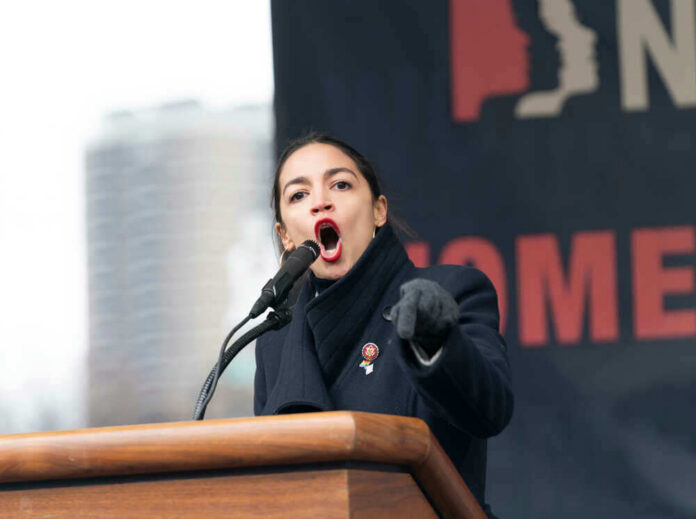
Alexandria Ocasio-Cortez says the next few years form a “very unique political window,” and she is keeping the White House on the table.
Story Snapshot
- Ocasio-Cortez told The New York Times she will weigh a presidential bid after the midterms.
- Her options for 2028 include staying in the House, seeking the Senate, or running for president.
- She framed timing and leverage as key to her decision, not deference to party elders.
- Public comments show she has not ruled out a White House run in 2028.
A deliberate message: options, timing, and leverage
Representative Alexandria Ocasio-Cortez used a high-profile interview to lay out her choices for 2028: keep her House seat, challenge for the Senate, or enter the presidential race, adding that she will decide after the midterms.
She described a “very unique political window,” signaling that timing and coalition strength will drive her choice, not tradition or seniority. That framing preserves flexibility, invites allies to organize, and keeps donors engaged without a formal campaign launch.
Her public posture also fits a modern pre-campaign playbook. Politicians signal interest to test reactions while avoiding the costs of a declared run.
Research shows this kind of ambiguity can be electorally helpful because it lets different voters project their hopes onto a potential candidate without firm lines that turn some away.
Media incentives amplify the effect because open questions draw coverage and keep her name in circulation without ad spending.
AOC reveals what it will take for her to seek White House or Senate https://t.co/lLO4a8LtN5 pic.twitter.com/MLrtskWpJb
— New York Post (@nypost) September 20, 2026
What she said, and what it implies for 2028
The New York Times reported that Ocasio-Cortez will weigh a presidential decision after the midterms and faces a real fork in 2028: White House run or a challenge for the Senate seat now held by Senator Chuck Schumer of New York.
She added that “deference” would not decide her path, a clear sign she will not wait in line simply because others expect it. That stance projects confidence and underscores a belief that windows in politics close fast if you hesitate.
Her other public comments match that line. She has not ruled out a 2028 run and has spoken about how life planning and political planning collide, which only raises interest in her timing calculus.
None of this is a formal campaign. It is a controlled release of possibilities that invites supporters to build scaffolding now, so a final decision can land on ready ground later.
The map she would need to win
A White House bid from a New York progressive would require three tracks. First, party base consolidation in urban centers and on campuses. Second, outreach to working-class voters who want lower costs, safer streets, and reliable energy.
Third, reassurance to independents that big promises come with math and measurable results. Conservative voters will likely reject her platform, but many will still watch the discipline of her roll-out. Voters reward clarity on taxes, policing, and borders far more than vibes.
Her timing pitch also reveals how she reads the field. If midterms strengthen her ideological lane, pressure grows to move. If not, a Senate path may look smarter. That is a standard risk filter. Ambition without a base fails fast; ambition with a base forces others to adapt.
The interview signaled she wants leverage either way, and leverage in politics often comes from the credible threat to run at the top of the ticket.
Media dynamics and the horse-race machine
Reporters chase signals like these because strategy and odds drive clicks and conversation. Political communication research calls this “horse-race” framing, where the spotlight lands on who is up, who is down, and what the next move could be.
The approach draws attention, but it also shapes behavior. When coverage treats hints as news, hints become tools. That benefits a figure like Ocasio-Cortez, who excels at setting the agenda with short, high-impact statements that travel far online.
Influential Democrats are already lining up behind Alexandria Ocasio-Cortez for 2028, comparing her potential run to Obama's 2008 upset. Do you want AOC in the White House? pic.twitter.com/ahlCNJ0yk5
— Victoria Ellis 🇺🇲🇺🇲❤️ (@Ellis5ol) September 21, 2026
Readers should separate two things. On one hand, the facts: she laid out her options and tied her choice to the midterm picture, keeping 2028 open. On the other hand, the media loop: every fresh hint breeds more stories, which can inflate perceived momentum.
Judgment should rest on performance, policy, and results. That is common sense. If she runs, she will need to prove her ideas lower prices, raise wages, secure the border, and keep streets safe—without new chaos or new debt.
Sources:
yahoo.com, nytimes.com, nypost.com, asset.library.wisc.edu