
President Trump is signaling the Iran war may be nearing its end—yet the U.S. is simultaneously tightening a naval blockade that could make or break the peace talks.
See the video below.
Story Snapshot
- President Trump told Fox Business the U.S.-Iran war is “very close to being over” as negotiations are expected to resume on Thursday.
- The administration paired ceasefire diplomacy with a hard-power move: a U.S. naval blockade of Iranian ports announced Monday.
- Vice President JD Vance said weekend talks in Pakistan produced “a lot of progress,” but emphasized Iran will determine what happens next.
- Markets reacted to the prospect of de-escalation, with reports of Wall Street gains tied to expectations of a deal.
Trump’s “Very Close” Claim Meets a High-Stakes Deadline
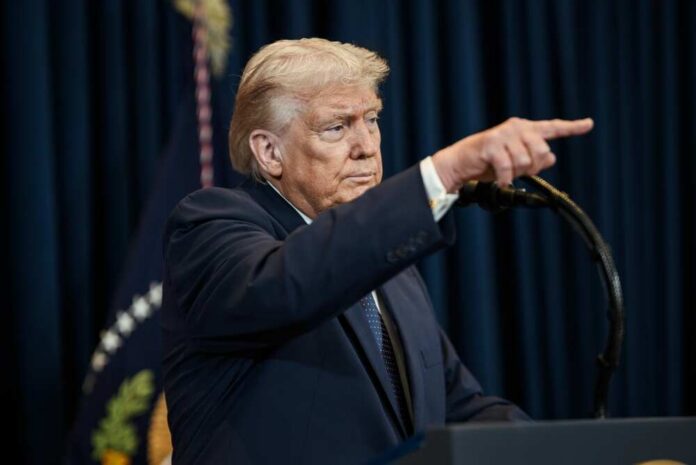
President Donald Trump said in a Fox Business interview with Maria Bartiromo that the conflict with Iran is “very close to being over,” describing Iran as eager to strike a deal as talks are expected to restart Thursday.
The statement landed amid a two-week ceasefire after the U.S. paused bombing operations last week. Trump framed the goal as preventing Iran from acquiring a nuclear weapon, a central justification for U.S. actions throughout the escalation.
Trump on Iran war:
I mean, I view it as very close to over. If I pulled up stakes right now, it would take them 20 years to rebuild that country. And we're not finished. We'll see what happens. I think they want to make a deal very badly.
Contributed by @AZ_Intel_. pic.twitter.com/JlWzkQUT0c
— Open Source Intel (@Osint613) April 15, 2026
Trump also connected diplomacy to economic confidence, predicting the stock market would benefit if tensions ease and a durable agreement takes shape. That linkage matters politically because Americans across the spectrum still feel squeezed by years of high costs, unstable energy prices, and fiscal uncertainty.
Even so, the reporting available so far provides no independent confirmation from Iranian leadership that a deal is imminent, making the timeline a test of whether optimism can survive real-world bargaining.
Naval Blockade Pressure Continues Despite Ceasefire Messaging
The administration’s approach blends negotiation with coercive leverage. Trump instituted a U.S. naval blockade of all Iranian ports on Monday, even as the White House publicly discussed de-escalation and an impending return to talks.
That combination signals a strategy of compelling concessions while negotiations remain open, rather than offering sanctions or military relief up front. Reporting also raised questions about enforcement and effectiveness, including claims that ships continued crossing near the Strait of Hormuz.
The Strait of Hormuz remains the strategic center of gravity because it is a key global oil transit route, and any disruption can ripple into fuel prices and broader inflation.
U.S. and Iranian positions reportedly diverge on the basic structure of a ceasefire, with mention of Iran offering a longer-term pause while the U.S. sought a shorter, conditional arrangement linked to Hormuz access. With so much economic exposure riding on shipping stability, even limited miscalculation could quickly reverse recent market calm.
What Vance’s “Ball Is in Iran’s Court” Framing Signals
Vice President JD Vance said weekend discussions in Pakistan made “a lot of progress,” but he also stressed that Iran will decide what happens next. That messaging attempts to define accountability: if talks collapse, the administration wants voters and allies to view Tehran—not Washington—as the party refusing a workable settlement.
Vance’s comments also fit a “grand bargain” concept focused on constraining Iran’s nuclear pathway, the non-negotiable objective cited by Trump.
This framing has an obvious appeal: it emphasizes a concrete national-security aim rather than open-ended nation-building. Additionally, the blockade posture and continued leverage can appear to be escalation by other means.
There are no details of any draft terms, verification measures, or enforcement mechanisms—key information needed to judge whether a prospective agreement would be lasting or merely a temporary pause.
Markets, Energy, and the Domestic Trust Problem
Reports tied Trump’s comments to Wall Street gains, reflecting investor belief that reduced conflict risk could stabilize energy markets and ease broader economic uncertainty. That relationship is not partisan; it is practical.
When Hormuz risk drops, shipping insurance and crude volatility often ease, and consumers can eventually feel it at the pump. Still, market optimism is not proof of peace, and the reporting does not quantify gains beyond describing them as significant.
Iran war 'very close to over,' Trump says — and the stock market 'is going to boom' https://t.co/I8mFxa3qXq
— CNBC Politics (@CNBCPolitics) April 15, 2026
The bigger domestic question is credibility. Many Americans—right and left—believe federal institutions too often sell narratives, while the public pays the cost through inflation, higher borrowing costs, and instability.
In this case, the verifiable facts are narrow but important: Trump expressed confidence, the blockade remains in place, the ceasefire window is limited, and talks are expected to resume on Thursday after a stalled round. Until Iran publicly confirms direction and terms, “very close” remains a political signal, not a finalized outcome.
Sources:
Trump says Iran war is ‘very close to being over’ as peace talks are expected to resume
Trump says Iran war is “very close to being over” as peace talks expected to resume