

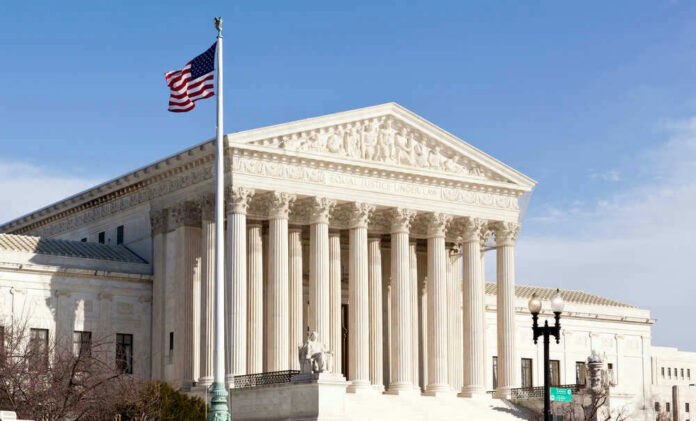
The House blocked a Republican-backed constitutional amendment to lock the Supreme Court at nine justices, and the fight now shifts to public opinion and the states.
Story Snapshot
- The proposal would cap the Court at one chief justice and eight associate justices.
- Republicans advanced the measure through committee but lacked supermajority support on the floor.
- Backers warned against future “court packing” if Democrats regain full control.
- Nine justices has been the norm since 1869, but the Constitution does not set a number.
What the amendment said and why it mattered
House Joint Resolutions 1 and 28 said the Supreme Court “shall be composed of nine justices,” naming one chief and eight associates, with the goal to fix the size by constitutional text rather than statute. Sponsors argued a hard cap would remove the temptation to add seats for short-term gain.
They pointed to a century and a half of steady practice at nine as proof the number works. That argument drew strength from history, not from a constitutional command.
Republicans made the case that locking the number would cool a coming arms race. They cited recent Democrat talk of expansion and said a future majority could tilt the Court by adding seats. They described the amendment as a guardrail, not a power grab.
That posture matches a set of clear rules that outlast swings in power. The House defeat shows many members were not ready to put that rule into the Constitution.
How far the effort got inside Congress
The proposal did not stall in a back room. The House Judiciary Committee advanced it on a party-line vote, signaling real intra-party buy-in. Representative Dusty Johnson highlighted dozens of cosponsors, showing organized support beyond a single faction.
But constitutional amendments demand two-thirds support in both chambers, plus state ratification. It was reported that Republicans simply did not have the math to clear that bar, which is why the floor push failed.
House Democrats on Wednesday overwhelmingly voted against a constitutional amendment to set the number of Supreme Court justices at nine. https://t.co/Xx6Rm1Mlb8
— The Washington Times (@WashTimes) September 2, 2026
Failure at this stage does not end the idea. Amendments often take years and several Congresses. Supporters may now aim to shape public views and rally state-level voices.
They can also introduce parallel statutory measures, though scholars agree that Congress can already change the Court’s size by law. The catch is obvious: a future Congress can change it back. That is why backers sought the permanence of constitutional text.
What opponents argued instead
Democrats framed the amendment as a preemptive lock on today’s ideological balance. They argued there is no active bill to expand the Court, so a cap solves a problem that does not exist.
Some also raise a structural point: there are 13 federal circuits but only nine justices, a mismatch that critics say can strain coverage and case selection. They also tie the Court’s legitimacy issues to past nomination battles rather than its size, and prefer different reforms to a numeric cap.
🗳️ HOUSE VOTE ❌
On Motion to Suspend the Rules and Pass
H.J. Res. 1 — Nine justices on the Supreme Court📊 Result: FAILED (212-206, 2/3 required)
🔴 GOP: 211Y-0N | 🔵 Dem: 1Y-205N | ⚪ Ind: 0Y-1N
⚔ Crossed party lines: 🔵 Davis (NC)
💡 What this means:
Every voting House…— congressX (@Congress_X) September 2, 2026
On the facts, both sides accept the same baseline. The Constitution does not set a number. Congress has changed it in the past. The Court has stayed at nine since 1869. That is why this fight is about incentives and restraint.
Adding seats each time power shifts invites a spiral that hollows the Court’s standing. Opponents respond that flexibility should remain in elected hands, and that capping now entrenches one moment’s tilt.
Why nine remains the political center of gravity
Nine has become a civic habit. Voters grew up with nine. The number signals stability to people who do not follow docket charts. That cultural weight is why lawmakers across cycles pledge “keep it at nine,” even while admitting the Constitution is silent on it.
Senator Todd Young and Senator Ted Cruz echoed that case in the Senate, saying expansion is a bad idea and that a cap would protect the Court’s credibility against partisan pushes to add seats.
History still whispers a warning. Past attempts to expand the Court, like President Franklin Roosevelt’s push, left scars that outlasted the bills themselves. The House defeat does not settle the matter.
Sources:
cbsnews.com, congress.gov, reuters.com, dustyjohnson.house.gov, ms.now, constitutioncenter.org