

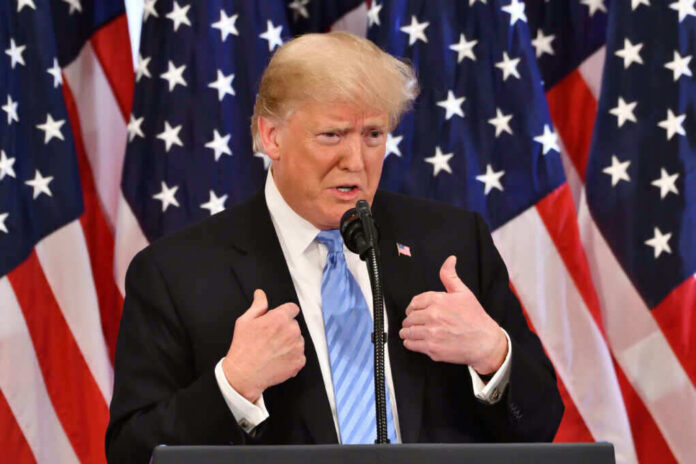
Trump’s latest approval dip is not just another bad headline; it is a stress test of how much turbulence voters are willing to tolerate before they start jumping off a moving train.
Story Snapshot
- A New York Times/Siena poll places Trump’s approval at 37%, triggering “new low” headlines.
- Polling averages cluster in the high 30s to around 40%, confirming genuine weakness, not a one-off fluke.[1][4]
- Support is eroding on the economy and among some Trump-leaning demographics, especially younger and nonwhite voters.[2][4]
- Conservatives face a choice: blame “bad polls,” or read the trend as a warning about performance and message discipline.
When One Ugly Number Becomes a National Rorschach Test
Media outlets splashed the 37 percent New York Times/Siena approval rating across screens as if a trapdoor had opened under Donald Trump. Supporters scoffed at “New York Times math,” while critics treated the number as moral vindication. The fight is not really about 37 versus 39. The deeper question is whether this poll represents a noisy snapshot or the moment when a long grinding slide in patience with Trump crosses a psychological line for millions of voters.[1]
Poll averages tell a calmer story than the screaming chyrons. The FiftyPlusOne tracker, which blends multiple surveys, shows Trump hovering around 37 percent approval and nearly 60 percent disapproval, a net of roughly minus twenty.[1] Statista’s compilation has him at about 40 percent approval earlier in May, pointing to the same basic reality: Trump is stuck in the high 30s to 40 percent range, not free-falling, but clearly underwater with the broader public.[4]
Trend Lines, Not Headlines, Reveal the Real Problem
Political history shows presidents can govern for years with approval in the low 40s; high 30s is a different neighborhood. Once a president settles there, it signals more people have decided they oppose him than are merely grumbling. The current numbers suggest a durable coalition of strong disapprovers forming around half the country, while the “soft support” column grows thinner. That dynamic limits room for error and magnifies every new crisis or misstep into a potential approval shock.[1][4]
For conservatives, the worrying part is not simply that Trump is disliked by Democrats. That has been baked in for a decade. The concern is that among independents and some right-leaning voters, frustration is shifting from “I wish he’d tweet less” to “I am not sure this is working.” When people who broadly agree with Trump’s policy instincts start downgrading their confidence in his competence or steadiness, approval numbers become less about ideology and more about perceived job performance and personal discipline.[1][4]
What The New Low Says About Trump’s Coalition
Recent public polling and commentary show erosion where Trump can least afford it: voters who once gave him the benefit of the doubt on the economy and promises kept.[2][4] Surveys cited in news coverage describe slippage among younger adults, Hispanic voters, and some Asian voters, groups that had shown surprising openness to Trump’s economic and cultural pitch earlier in his political career.[2][4] These are not traditional Republican base voters; they are transactional, and they are sending a transactional message.
Economic approval is a particular red flag. For years, Trump’s strongest argument was, “You may not like the noise, but you like your wallet.” Now, polls referenced by outlets such as CBS and Statista show his economic approval slipping toward the low thirties to around forty percent.[2][4]
When a president who brands himself as a business turnaround expert looks shaky on basic kitchen-table questions, conservatives should not dismiss that as mere media spin; they should ask what policy and communication choices are dulling that former edge.
Are The Polls Rigged, Or Is Reality Just Uncomfortable?
Trump and many of his allies argue that polls like New York Times/Siena oversample Democrats, undercount working-class supporters, or use loaded wording. Skepticism about elite media polling is understandable, given clear historical misses and cultural bias in newsrooms. But the methodological critique loses force when independent aggregators, niche data sites, and even business-oriented trackers all converge on similar numbers in the high 30s to low 40s.[1][4][5]
Trump approval rating hits second-term low in new pollinghttps://t.co/05kx1RraoA
— The Hill (@thehill) May 18, 2026
Common sense, rooted in conservative skepticism of wishful thinking, suggests this: when every thermometer on the wall reads a fever, the answer is not to smash the thermometers. The healthier instinct is to separate noise from signal. The exact 37 percent figure will bounce; polls always do. The signal is that Trump’s second-term honeymoon ended quickly, and the public now judges him by tangible outcomes, not nostalgia or anger at his opponents. That shift narrows the margin for rhetorical indulgence.[1][4]
What Voters Are Quietly Saying Between The Lines
Approval ratings are blunt instruments, but they often hide a very specific voter message. Right now, that message sounds like: “We want order, prosperity, and clarity, not never-ending chaos theater.” Many Americans still prefer Trump’s policy instincts to progressive alternatives on crime, border security, and economic freedom, yet they hesitate to reward behavior that feels undisciplined or self-absorbed. A conservative reading of the moment treats this as constructive feedback, not betrayal.
If Trump focuses relentlessly on competence, results, and basic steadiness, these numbers can climb back into the low or mid 40s, which history suggests is enough to govern and compete. If he dismisses all negative polling as fake and doubles down on grievance, the high 30s could become the new normal. The crack in the polling floor is not destiny; it is a warning siren about the limits of personality politics when voters are asking an older, colder question: “Is this working for my family?”
Sources:
[1] Web – Latest Donald Trump Approval Polls and Average for 2026
[2] YouTube – Latest CBS poll shows Trump’s approval ratings hitting all-time lows
[4] Web – Trump presidential approval rating U.S. 2026 – Statista
[5] Web – Donald Trump favorability 2016-2026 – YouGov