

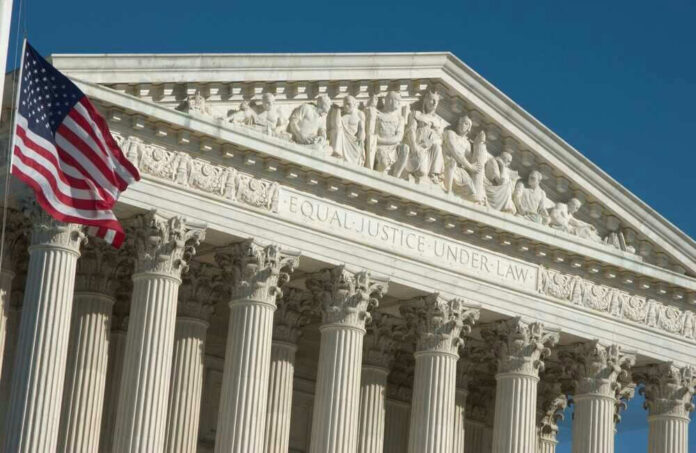
Voters said yes, courts said no, and the United States Supreme Court just left Virginia’s political map right where the calendar—not the partisans—put it.
Story Snapshot
- United States Supreme Court declined to revive Virginia’s voter-approved congressional map, leaving a state court’s invalidation in place [2].
- Virginia Supreme Court ruled 4-3 that lawmakers violated state constitutional procedure by advancing the amendment after early voting began [4].
- Democratic officials argued millions of voters were nullified and federal election law was misread, but the emergency bid failed [1].
- The fight pivots on timing and process, not just partisanship—an increasingly common pattern in redistricting battles [2][4].
What the United States Supreme Court did—and did not—decide
The United States Supreme Court issued a short order rejecting Virginia’s emergency request to reinstate a voter-approved congressional map that would have advantaged Democrats, leaving intact the Virginia Supreme Court’s invalidation of the amendment authorizing the lines [2].
The order did not address the merits of Virginia law. It left the last reasoned decision—the state court’s procedural holding—in place for the coming elections. That posture matters: it signals no federal rescue while preserving state control over state constitutional sequencing [2].
BREAKING: The Supreme Court rejects Virginia's bid to restore a congressional map favoring Democrats. https://t.co/WrcexMohCv
— The Associated Press (@AP) May 15, 2026
Virginia’s argument leaned on the referendum’s legitimacy and a federal law claim. State Democratic leaders asserted the Virginia Supreme Court misread federal election law by counting early voting as part of the general election and thereby disqualifying the legislature’s timing; they said the ruling “nullified the votes of millions” who approved the map [1].
The emergency request invited the United States Supreme Court to correct the state court’s reading. The justices declined, a result that leaves process—rather than partisan fairness—front and center [1][2].
Why the Virginia Supreme Court’s clock beat the map
A 4-3 Virginia Supreme Court majority held that the General Assembly failed to follow the Virginia Constitution’s required process for placing the amendment before voters, rendering the referendum result invalid [2]. Reporting on the opinion describes a core defect: lawmakers advanced the measure after early voting had already begun, violating the constitutional timing rule and “irreparably” undermining the referendum’s integrity [4].
The court’s focus stayed on sequence and authority, not how many voters ultimately supported the change. When calendars govern, popular votes cannot cure procedural missteps [2][4].
Supporters framed the voter-approved map as a corrective to partisan redistricting in Republican-led states and a way to blunt newly enacted lines elsewhere, making the measure part of a national tug-of-war over seats rather than a technical tweak [4].
That narrative, while politically resonant, collided with a process-centric ruling that asked a narrower question: did legislators meet Virginia’s constitutional prerequisites before asking voters? The justices’ answer—no—carried immediate operational consequences that partisan talking points could not outrun [2][4].
The referendum mandate versus the rulebook
Democracy Docket reported that more than three million Virginians participated and that a majority approved the amendment, a turnout number supporters cited to argue democratic legitimacy [1]. CBS News likewise described the plan as a voter-approved congressional map [2].
The Virginia Supreme Court’s decision treated those votes as downstream of a flawed upstream process, emphasizing that constitutional guardrails exist to prevent last-minute structural changes mid-election. The legal message: public support cannot validate an improperly teed-up amendment [2][4].
Democratic officials insisted the state court misunderstood federal Election Day law by calling early voting part of the general election, a reading they argued overextended a federal timing rule and clashed with common-sense administration where early ballots precede, but do not redefine, Election Day [1].
The state court’s approach aligns with a predictable principle: once an election cycle starts, changing the rules midstream invites confusion and undermines confidence. Stability of process outlasts the passion of any momentary majority [2][4].
What this signals for the national map fight
This episode fits a broader pattern: modern redistricting fights often turn on procedural tripwires rather than cartographic artistry. Courts will scrutinize timing, notice, and constitutional prerequisites more ruthlessly than they police partisan advantage, especially on emergency dockets where institutional caution runs high [2][4].
Because the United States Supreme Court offered no merits opinion, both camps remain free to argue fairness; yet only one side controls the calendar now, and that is the side with a validated process, not the flashier map [2].
Future attempts to rework Virginia’s lines must start with a precise legislative record and a disciplined election timeline. That means session notices that match constitutional text, ratification milestones completed before any ballot is cast, and a clean administrative trail. Without that, even a supermajority referendum can fall to a stopwatch. Voters can choose the destination; the constitution dictates the route. In Virginia, the route—not the rhetoric—decided the map this cycle [2][4][1].
Sources:
[1] Web – Supreme Court refuses to restore Virginia redistricting plan …
[2] Web – Supreme Court rejects Virginia Democrats’ bid to revive … – CBS News
[4] Web – Supreme Court rejects bid to restore Virginia’s redistricting map …