
A quasar born just 630 million years after the Big Bang has become the most distant one astronomers have ever confirmed, pushing the edge of the observable universe back even further than before.
Story Snapshot
- Scientists identified a quasar named J1504+6252, nicknamed Dún Aonghasa, at redshift 8.13.
- The object’s light left it about 13.1 billion years ago, when the universe was roughly 630 million years old.
- It holds a black hole estimated at 360 million times the mass of our sun.
- The find beats the previous distance record by about 40 million years and came from the European Space Agency’s Euclid telescope.
What Euclid Actually Found
The European Space Agency reports that its Euclid telescope spotted J1504+6252 at a redshift of 8.13. That number tells scientists how much the light from the object stretched out on its long trip to Earth. A redshift that high means Euclid is looking back roughly 13.1 billion years, to a universe only about 630 million years old.
The discovery traces to a paper titled “Euclid: Discovery of a quasar at z = 8.13 hosting a 360-million solar-mass black hole,” published by J. Wolf and colleagues in Astronomy & Astrophysics. A German-led research team announced the find, working alongside the Max Planck Institute for Astronomy, which also confirmed the object and its Euclid origin.
Researchers gave the quasar a nickname instead of just a string of numbers and letters. They called it Dún Aonghasa, after an ancient stone fort perched on a cliff in Ireland. The name fits an object that sits at the edge of what telescopes can see, a lonely outpost from the universe’s earliest chapter.
A Black Hole That Grew Up Fast
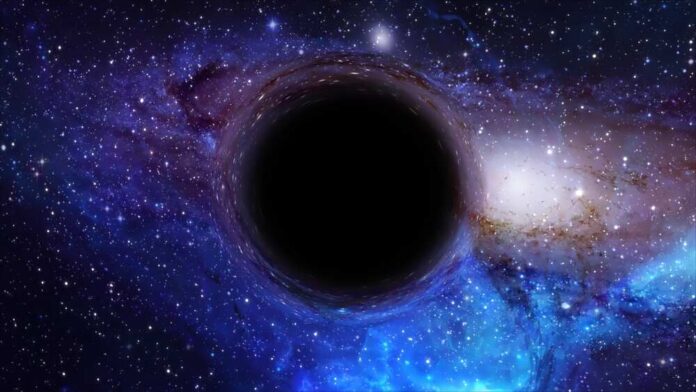
A quasar is the blazing core of a galaxy, powered by a supermassive black hole swallowing gas and dust at enormous speed. The European Space Agency estimates this one carries a black hole with about 360 million times the mass of the sun, packed into a galaxy that existed when the universe was barely 5 percent of its current age.
The Max Planck Institute for Astronomy describes the find as tightening the constraints on how black holes form in the early universe. A black hole that massive, that early, forces scientists to explain how it grew so big so fast, since standard growth models need more time than 630 million years allows.
This is not a new puzzle for astronomy. Reviews of early black hole growth have long noted that quasars discovered at high redshift keep arriving earlier than theory comfortably predicts, with hundreds of such objects already catalogued beyond redshift 6. Each new record adds pressure to that same unresolved question.
Breaking A Record Euclid Already Held
The European Space Agency frames this discovery as Euclid beating its own previous mark by about 40 million years, making J1504+6252 the first confirmed quasar beyond redshift 8. The Max Planck Institute for Astronomy echoes that framing, calling it a new distance record for the mission.
Records like this tend to be temporary by nature. Astronomers label an object the most distant “known” or “to date” because surveys like Euclid, along with the James Webb Space Telescope and ground-based instruments, are actively hunting for objects even further back in time. The title belongs to whoever holds the current best-confirmed measurement, nothing more and nothing less.
Recent observations with the Large Binocular Telescope have led to the discovery of the most distant known quasar, detected in the light it emitted only 630 million years after the Big Bang. https://t.co/4DaljhHkjd pic.twitter.com/zmPCBPt3Jf
— Large Binocular Telescope Observatory (@LBTObs) November 24, 2026
That reality does not diminish what Euclid accomplished here. Confirming a quasar at redshift 8.13 required catching a faint signal from an object whose light has been traveling since before most of the universe’s stars, galaxies, and heavy elements had formed. It stands today as a genuine marker of how far telescope technology has advanced.
Why This Matters Beyond The Numbers
Every time astronomers push the quasar frontier earlier, they hand theorists a tougher problem. Supermassive black holes are not supposed to form overnight, yet one keeps turning up anyway, galaxy after galaxy, deeper into cosmic history. Dún Aonghasa is simply the latest and farthest example of that pattern holding steady.
For now, J1504+6252 stands as the earliest confirmed quasar humanity has observed, a 360-million-solar-mass black hole shining out from a universe just 630 million years young. Future surveys from Euclid and other instruments will likely test that record again, as they always do.