
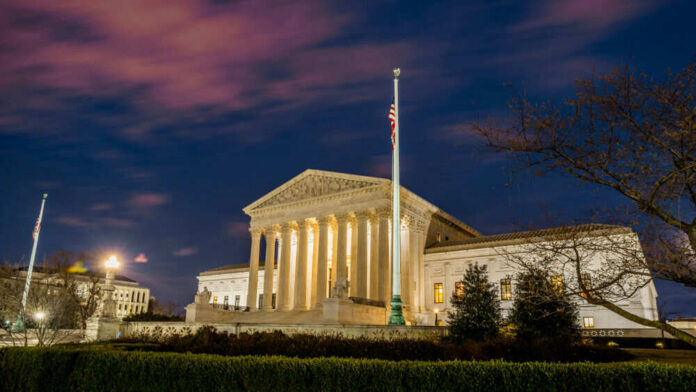
The Supreme Court will decide whether Congress can ban stills in your backyard to protect a tax that helped pay for the Civil War.
Story Snapshot
- The Court will rule on a 160-year-old federal restriction on distilling spirits at home.
- The Fifth Circuit struck the location ban as beyond Congress’s taxing power.
- The Sixth Circuit upheld the same rule, creating a direct split.
- The case turns on the Necessary and Proper Clause, not a lifestyle right.
What the Supreme Court Agreed to Decide
The justices granted review on whether Congress can forbid distilling in a house, yard, or attached shed to carry out its taxing power. The statute at issue, 26 U.S.C. § 5178(a)(1)(B), locks distilling out of dwellings and connected structures. The Court framed the question under the Necessary and Proper Clause, which asks if the rule is needed and proper to execute the federal tax on spirits. Respondents do not claim a new right to moonshine. They argue the ban strays beyond enumerated powers.
The federal government says the ban exists to protect a major revenue stream. It argues that people can hide a still more easily in a home and dodge inspections, proof checks, and the correct tax rate. The Solicitor General’s office told the Court that a measure can stand if it is convenient or useful and plainly adapted to tax collection. On that view, keeping stills out of houses curbs evasion and so fits the Constitution.
How the Fifth Circuit Blew Up a 19th-Century Rule
The Fifth Circuit said the location ban is not “plainly adapted” to tax collection. The court found a mismatch: the law blocks all home distilling rather than regulating it, which can reduce rather than raise receipts. The panel warned the government’s theory had no clear stop. If Congress can criminalize any at-home act that risks tax loss, it gains a general police power the Constitution withholds. That crosses the line the Necessary and Proper Clause sets.
The Fifth Circuit’s means-end critique hit at the government’s logic. If the point is to collect taxes, then rules that channel production into a permit-and-reporting system would make more sense. A flat ban in certain locations collects no tax there at all. The court also stressed the law’s breadth, noting it sweeps in a hobbyist with no sales and no commercial aim. That reach signaled an independent police rule dressed up as tax enforcement.
Why a Circuit Split Forces a National Answer
The Sixth Circuit saw the same history and came out the other way. It accepted that tax evasion plagued spirits production after the Civil War and that keeping stills out of homes helped revenue enforcement. It labeled the restriction a necessary and proper tool to secure the excise tax, siding with Congress’s long practice and the Treasury’s on-the-ground needs. That direct conflict with the Fifth Circuit left uneven law and pushed the Supreme Court to step in.
The government leans on that history to underscore stakes. It points to centuries of evasion and notes that the distilled-spirits tax yielded large sums at the founding and still brings in billions today. It claims the home ban reduces concealment risk, supports inspections, and protects rate integrity tied to alcohol proof. That concrete revenue story, not a safety claim, is the backbone of its case to keep the rule.
What Changes Now for Home Distillers and Regulators
Nothing changes nationwide until the Supreme Court rules. The Fifth Circuit decision removed the federal location bar inside that circuit, but it did not erase permits, excise taxes, or reporting. The Alcohol and Tobacco Tax and Trade Bureau still runs the permit process, and state and local laws still bind. Even if the location ban falls, a person would still face other federal and state hurdles to run any still, even for personal use.
The Supreme Court agreed on Monday to decide the legality of a federal ban on the home distilling of alcoholic spirits that was enacted in 1868 after the US Civil War to crack down on liquor tax evasion. https://t.co/OC4dONKTPm
— Reuters Legal (@ReutersLegal) October 19, 2026
The deeper fight is about guardrails on federal power. If the Court affirms the Fifth Circuit, it will signal that Congress cannot pad tax laws with free-standing police bans, especially inside the home. If it adopts the government’s view, it will bless broader leeway to lock down places where evasion is easier. For readers who value limited government and clear lines, the key is this: taxes are for revenue, not for a backdoor national police code.
Sources:
cbsnews.com, supremecourt.report, cato.org, courthousenews.com, washingtonpost.com, supremecourt.gov, scotusblog.com