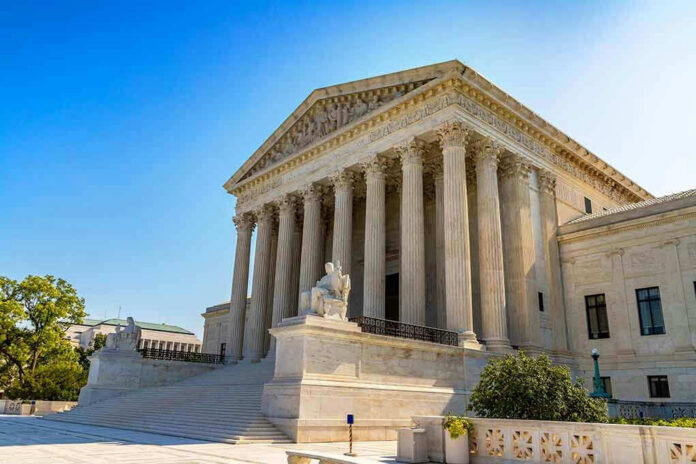
Justice Samuel Alito just pulled himself off one of the biggest climate cases the Supreme Court will hear all year.
Quick Take
- Supreme Court Clerk Scott S. Harris told both sides on September 28, 2026, that Alito “will not continue to participate” in Suncor Energy Inc. v. County Commissioners of Boulder County.
- The case, set for oral argument October 5, 2026, decides whether Boulder County can sue Suncor Energy and Exxon Mobil in state court over climate damages.
- Alito reportedly owns stock in several oil and gas companies, though not in Exxon Mobil or Suncor Energy directly.
- The Court gave no written reason for the recusal, following its long-standing practice of not explaining these decisions.
A One-Sentence Letter Upends a Landmark Climate Case
The notice was short and blunt. Clerk Scott S. Harris sent a single sentence to lawyers on both sides stating that Justice Alito would step away from the case entirely.
No explanation came with it. Lawyers for Suncor Energy, Exxon Mobil, and Boulder County officials all received the same message just one week before scheduled oral arguments.
News outlets from Reuters to CBS News to Politico ran the story within hours of each other, all pointing to the same clerk’s letter dated September 28, 2026.
That kind of near-simultaneous coverage happens rarely at the Court, and it signals how much weight this case carries. Boulder’s lawsuit could decide whether dozens of similar climate lawsuits against oil companies survive nationwide.
Alito bows out of blockbuster Supreme Court climate case https://t.co/w6l6i5s4Zo
— POLITICO (@politico) September 28, 2026
What The Case Actually Decides
Boulder County sued Suncor Energy and Exxon Mobil years ago, arguing the companies should pay for local damage tied to climate change. The oil companies want the fight moved out of state court and blocked under federal law instead.
Reports differ slightly on whether the core legal question is preemption or jurisdiction, but the stakes are the same either way. A ruling for Suncor could shut down similar suits nationwide.
That makes the timing of Alito’s recusal especially notable. Oral argument was locked in for October 5, 2026, giving the eight remaining justices exactly one week to prepare without him.
Losing a justice this close to argument is unusual, and it puts more weight on the remaining bench in a case already expected to produce a narrow, closely watched decision.
Why Stock Holdings Are At The Center Of This Story
Reuters and other outlets reported that Alito holds stock in several oil and gas companies, though not in Exxon Mobil or Suncor Energy, the two companies actually named in the case.
Federal law requires judges to step aside when they hold a financial interest “in the subject matter in controversy,” a standard that applies even without holding stock in the exact companies involved. Legal scholars note this rule is strict. It applies no matter how a judge would have ruled.
No financial disclosure form or formal ethics memo has surfaced publicly to spell out exactly which holdings triggered the decision. That gap is common at the Supreme Court, where justices are not required to explain recusal choices and their decisions cannot be appealed or reversed.
Legal researchers have called this one of the least transparent corners of federal judicial ethics, since the public typically sees only the outcome, never the reasoning behind it.
U.S. Supreme Court Justice Samuel Alito announced his recusal from the major climate change case Suncor Energy Inc. v. County Commissioners of Boulder County, stepping aside following intense public scrutiny over his personal financial holdings in oil and gas companies#News pic.twitter.com/iIl0D5Sj7E
— PEER COMMUNITY HUB, Our Empowerment Zone! 🇨🇦✌️ (@p_communityhub) September 29, 2026
Whatever the exact trigger, Alito’s choice to step back rather than risk an appearance of conflict lines up with what the recusal statute actually demands. Critics of the Court’s ethics record have spent years complaining that justices ignore financial conflicts.
Here, whatever the private calculation, a justice with oil and gas holdings chose not to rule on an oil and gas liability case. That is the system working as it is supposed to, even without a public explanation.
What Happens Next For Boulder and the Oil Companies
Oral argument remains on the calendar for October 5, 2026, now before eight justices instead of nine. A tie vote would leave the lower court’s ruling in place without setting a national precedent, a real possibility given the recusal.
Boulder County, Suncor Energy, and Exxon Mobil all now face a decision shaped by one less vote than expected, in a case that could still reshape climate litigation across the country either way.
Sources:
abcnews.com, cnbc.com, politico.com, pjmedia.com, dailycaller.com