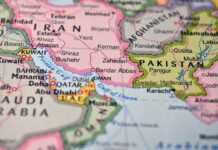
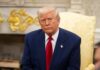
President Trump is warning Americans to brace for a multi-week Iran campaign that will intensify—because the alternative is letting Tehran’s nuclear and missile ambitions dictate the future of the Middle East.
Quick Take
- U.S. and Israeli strikes on Iran began on February 28, 2026, and the Trump administration has projected a four-to-five-week operation that will intensify over time.
- Early reports describe “decapitation” strikes that killed Iran’s Supreme Leader Ali Khamenei, followed by a rapid succession process installing Mojtaba Khamenei.
- Iran’s retaliation has included large ballistic-missile salvos and drone activity, with strikes reported in Israel and impacts tied to U.S. facilities in Bahrain.
- The conflict widened fast, with reporting indicating nine nations were directly involved by March 3, though public source material has not identified all nine.
What the White House is signaling about scope and duration
U.S. military operations against Iran began on February 28, 2026, with U.S. Central Command announcing airstrikes and Israel reportedly conducting leadership-targeting strikes shortly afterward.
President Trump has framed the campaign as time-bound rather than open-ended, describing a four-to-five-week window and signaling that the effort is designed to intensify, not wind down. Pentagon messaging has reinforced that the operation is not intended to be “endless.”
As conflict in Mideast widens, US says attacks on Iran will last weeks and intensify https://t.co/ZDSXvj1EwE
— WPMT FOX43 (@fox43) March 3, 2026
The available research points to clear strategic goals discussed publicly and in analysis: stopping Iran from achieving nuclear capability, dismantling Iran’s missile program, neutralizing naval threats, and protecting U.S. regional interests.
Those objectives matter to Americans at home because they shape whether the U.S. faces a stronger, more emboldened Iranian regime capable of coercing neighbors, threatening shipping lanes, and raising the odds of a wider war that drags in U.S. troops.
How the opening days escalated—and why the region is on edge
Reporting in the timeline research describes a rapid escalation: Iran fired roughly 170 ballistic missiles in retaliation within hours of the opening strikes, with impacts reported in Israel and missile strikes also confirmed at a U.S. Navy Fifth Fleet service center in Bahrain.
Bahrain later reported intercepting dozens of missiles and drones. The timeline also notes U.S. casualties, with six U.S. service members confirmed killed in action as the conflict intensified.
Military activity accelerated on March 1 as Israel launched additional strikes and the U.S. employed B-2 bombers against hardened ballistic-missile facilities.
The research also records a confusing diplomatic moment: President Trump said he accepted an Iranian proposal for further negotiations, but an Iranian official later ruled out talks. That contradiction underscores a practical reality in fast-moving conflicts—messaging and internal decision-making can diverge, especially inside authoritarian systems.
Leadership shock in Tehran and what it means for stability
The timeline research describes a major political shock: the killing of Supreme Leader Ali Khamenei and dozens of senior officials in initial strikes, followed by Mojtaba Khamenei being selected as the new Supreme Leader by March 3.
This kind of sudden leadership turnover is not a side detail—it can affect command-and-control, retaliation decisions, and how various power centers inside Iran compete to prove legitimacy, often by escalating rather than de-escalating.
On the civilian side, the research points to disruptions that typically accompany heavy conflict and authoritarian control: Iran experienced an extended internet outage, restricted exports of food, and reported limited essential stockpiles.
Those facts do not, by themselves, prove any long-term political outcome, but they do show pressure building internally. U.S. and Israeli strikes may degrade military capability, yet the humanitarian and economic strain can also create unpredictable second-order effects.
Why energy security and the Strait of Hormuz are the immediate pressure points
Iranian threats described in the research include targeting economies of major regional cities and setting fire to ships transiting the Strait of Hormuz. That chokepoint is central to global energy flows, so even partial disruption can ripple into prices that hit American families and retirees.
The U.S. response has included signaling a willingness to escort oil shipments through the strait if necessary, aiming to deter Iran from turning a regional war into a global energy crisis.
The research also says the conflict expanded to involve nine nations by March 3, without publicly naming all participants in the provided materials.
That gap is important for readers who want clarity: without a verified list, sweeping conclusions about “who is in” and “who is out” should be avoided. What is clear is that the operational tempo and the stated multi-week timeline raise the stakes for U.S. forces, regional allies, and energy markets.
Sources:
Prelude to the 2026 Iran conflict
Timeline of the 2026 Iran conflict
Iran Update Special Report: US and Israeli strikes, February 28, 2026