

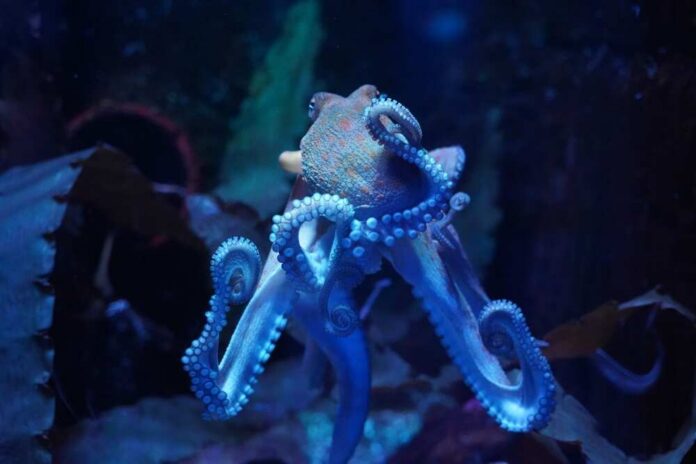
A palm-sized electric-blue octopus surfaced from 5,900 feet down to rewrite a chapter of Galápagos natural history—and it did it with one specimen and no ink sack to hide behind.
Story Snapshot
- Scientists formally described a new deep-sea octopus, Microeledone galapagensis, from near Darwin Island in the Galápagos [4].
- The specimen was first seen in 2015 by a remotely piloted submersible during the exploration vessel Nautilus expedition [2].
- Key traits include tiny body size, bright blue coloration, few arm suckers, and the absence of an ink sac [3].
- The formal description is based on a single female collected at about 5,800–5,900 feet below the surface [7].
A blue spark from the abyss, finally named
Researchers tied a striking deep-sea sighting to a formal species description, Microeledone galapagensis, after nearly a decade of work from initial video to peer-reviewed taxonomy [4].
The octopus was encountered on underwater mountains near the Galápagos Islands, where the team documented a golf ball-sized animal with an unmistakable cobalt hue [3].
The new species designation reflects detailed comparisons against known octopuses and a suite of traits that hold up under the taxonomic microscope, not just a photogenic color splash [3].
The new species, named Microeledone galapagensis, has a blue hue, which is believed to be the rarest color in nature. https://t.co/OBPE0jWmSu
— CBS News (@CBSNews) May 26, 2026
Field crews first spotted the animal in 2015 using a remotely operated robot from the exploration vessel Nautilus near Darwin Island, a hotspot for seamount biodiversity and cold, current-swept substrates [2].
The depth—about 5,900 feet—places the species in a frigid, high-pressure world where energy is scarce, and camouflage is literal life insurance [9].
The persistence in returning, documenting, and collecting a specimen for study bridges the dramatic live sighting and the quiet, meticulous science of species diagnosis [7].
What makes Microeledone galapagensis different
Taxonomists flagged several features that separate this animal from lookalikes: small stature that can curl into a palm, few suckers arranged in a single series along each arm, smooth skin with minimal pigment, and no ink sac—an adaptation often lost in deep-sea lineages where inky smokescreens provide little advantage in darkness [3].
The species lives at roughly 5,800 feet, a depth zone that filters out red light and rewards blue tones, which appear muted in situ but blaze under lights and cameras [4].
The name Microeledone places it among compact-bodied octopuses with reduced ornamentation and streamlined anatomy suited to conserving energy at depth [3].
The species was formally recognized based on a single collected female, a standard yet demanding foundation in deep-sea taxonomy, where access is rare and ROV time is expensive [7].
A single type specimen can carry the load when the diagnostic characters are clear and repeatable, setting it apart from all known relatives [7].
From viral “It’s blue!” to sober science
Public headlines leaned into the color and size—“tiny,” “blue,” and “golf ball”—because those details hook eyes and spark shares, but the durable story is the taxonomic craft that followed the first gasp on camera [3].
The research community advanced from observation to collection to comparative anatomy and then to formal publication, the classic sequence that separates novelty from knowledge [4].
Claims about depth, location, and description rest on expedition logs and later peer-reviewed work, not on a social media echo chamber [2].
Critics sometimes wave off species stories built on a solitary specimen, yet deep-sea biology has always moved one deliberate chess piece at a time.
This case aligns with standards: a clear locale near Darwin Island, a documented depth of around 5,800–5,900 feet, and stable, distinctive characters that survive the checklist of comparisons [4]. The facts add up, and until a competing analysis dismantles those characters, the name stands on the merit of method and evidence [7].
Sources:
[2] Web – Researchers discover new golf ball-sized blue octopus species
[3] Web – “It’s blue!” Deep-sea scientists discover exciting new species in the …
[4] Web – Golf ball-sized octopus discovered near the Galápagos Islands
[7] Web – New Species of Octopus Discovered in Deep Waters … – Sci.News
[9] Web – ‘He’s tiny! It’s blue!’: Scientists find new deep-sea octopus – Geo …