

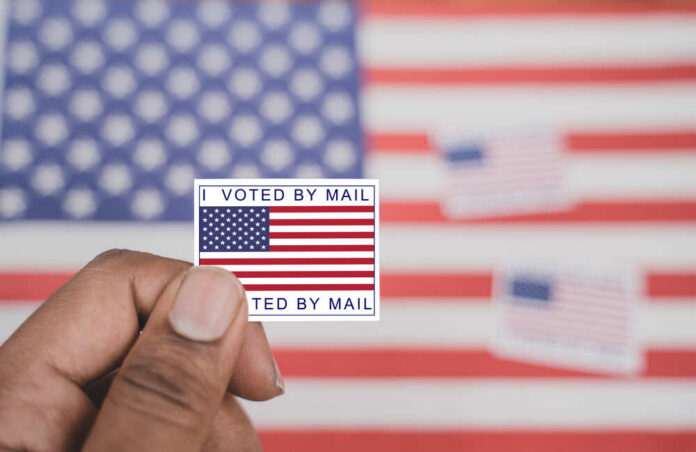
USPS just told states it will not carry their federal-election mail ballots unless each one is tied to a named voter and a unique barcode — and the fight over who runs voting now runs straight through the mailroom.
Story Snapshot
- USPS proposed and then finalized ballot-mail rules centered on unique barcodes and a federal portal.
- States would submit voter names, addresses, and barcode-linked data before ballots enter the mail stream.
- USPS says the data enables tracking, compliance checks, and supports law enforcement when needed.
- A court injunction clouds implementation; USPS says it will wait unless the court clears it.
What USPS Actually Put On The Table
The United States Postal Service published a proposed rule in the Federal Register that would change how it accepts mail ballots for federal elections.
The plan ties every outbound and return ballot envelope to a serialized barcode and to a specific voter, with the information submitted in advance through a Federal Ballot Mail Portal.
The final rule, issued later, formalizes that structure and sets publication schedules, though it will not take effect unless a court allows it to proceed.
The United States Postal Service has released a new rule adding verification requirements to all mail-in ballots. https://t.co/How6zwugny
— ABC News (@ABC) August 23, 2026
USPS already sets standards for election mail handling, envelope design, and tracking options. This rule goes further by conditioning ballot-mail acceptance on state-supplied lists matched to unique barcodes.
USPS frames it as logistics discipline and system visibility, not a grab at counting power. It does not decide voter eligibility or tally votes. It aims to ensure that each ballot that moves through the mail can be tracked, audited, and linked to the correct voter and election office.
The New Mechanics: Lists, Barcodes, And A Portal
State election officials would enroll in a federal portal and, before mailing, submit the name and address of each voter who will receive a ballot, along with the unique barcode printed on the outbound and return envelopes.
USPS would use that data to verify ballot mailings before accepting them into the mail stream and to monitor delivery and returns across its network. A news outlet reported that USPS says the barcodes help determine adherence to federal law and aid law enforcement when necessary.
The plan focuses on federal elections and would not cover primary contests. It also relies on Intelligent Mail barcodes already used in commercial mail but adds a requirement that every ballot be uniquely serialized.
That increases chain-of-custody clarity and makes mismatches easier to spot. It also centralizes sensitive voter-and-envelope data at the federal level, which heightens the stakes for privacy and cybersecurity.
The Rationale And The Pushback
USPS argues that standardized envelopes, unique barcodes, and pre-submitted lists let it police its own lanes. The postal network can then flag duplicates, catch format errors, and produce detailed scans when questions arise. Supporters, including a coalition of Republican state attorneys general, say the plan addresses real chain-of-custody gaps and should proceed.
A Major New Mail-In Voting Rule Is Ready to Go — but There's One Big Problem | Teri Christoph, RedState
Would it surprise you to know that a pair of socks you ordered from Amazon is far more trackable than your mail-in ballot, leaving your vote – arguably the most important kind… https://t.co/coyqHOHZ7D
— Owen Gregorian (@OwenGregorian) August 24, 2026
Opponents argue the system makes USPS a gatekeeper by conditioning ballot acceptance on state uploads and barcode matches. They warn that the portal and serialization create burdens, risk delays, and concentrate voter data.
Some Democrat attorneys general asked USPS to withdraw the rule. Others say current safeguards—registration checks and signature or identification verification on return—already protect mail voting, so the new scheme may be redundant.
What Changes On The Ground If It Sticks
Election offices would need to generate unique barcodes for outbound and return envelopes, align print runs, and upload accurate lists on time. They would also need to reconcile any reissues, address changes, or spoiled ballots to keep the barcode map clean.
USPS could then reject malformed batches before they enter the system, which fixes problems early but could also slow mailings if states stumble. The rule’s value depends on execution speed and data hygiene.
The enforcement picture remains thin in public view. Reporting describes verification against state lists and cooperation with law enforcement, but it lacks a detailed process for resolving mismatches or late changes.
Skeptics will ask how appeals work and how errors get corrected fast so voters are not stuck. Those questions matter more than rhetoric because a clean chain of custody means little if fixes arrive after Election Day.
The Legal Cloud And The Practical Clock
USPS published the final rule but said it would not act unless a court lifts an injunction. That means the edit is real, but the effect is pending. If courts greenlight the plan deep into the calendar, states may not have time to retool envelopes, print runs, and data feeds.
Tight timelines break systems, not just politics. The safer path, if the rule survives, is a phased start with clear cutoffs and public scorecards so voters see how it works.
Two truths can coexist. Voters deserve a mail system that tracks ballots like valuable parcels. States deserve time and clarity to meet any new standard.
The balance here is simple: demand visibility, but do not confuse bureaucracy with security. If USPS proves the portal improves accuracy without blocking eligible voters, it will earn trust. If it cannot, Congress should clarify the limits and let states lead.
Sources:
abcnews.com, app.govly.com, oag.ca.gov, reuters.com, grayhairsoftware.com, about.usps.com, nul.org, usatoday.com