

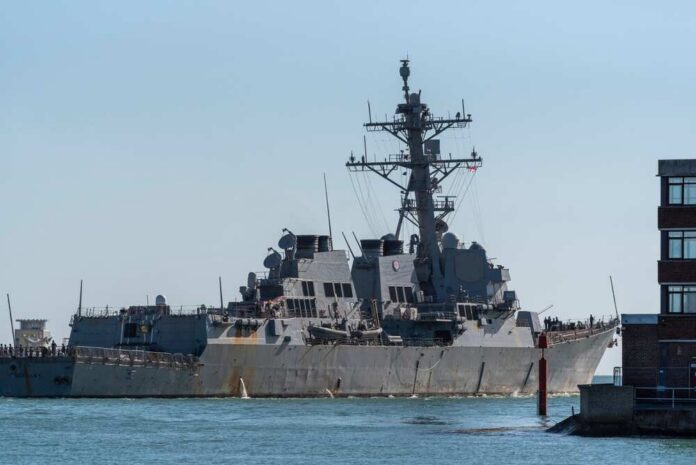
An American warship sat dead in the water for four days in one of the most contested seas on Earth, and its own generators were to blame.
Quick Take
- The USS Benfold, a guided-missile destroyer, lost all power on July 24 in the South China Sea after a generator failure.
- Sailors went four days without air conditioning, working toilets, potable water, or normal galley service.
- The Navy says no crew members were hurt and praised sailors for handling the outage with discipline.
- The ship was towed to Subic Bay in the Philippines, where repairs wrapped up in August.
- This is the second major Indo-Pacific power failure on a Navy destroyer this year, following the USS Higgins in May.
A Warship Goes Dark in Disputed Waters
The USS Benfold was sailing with the USS George Washington Carrier Strike Group when its generators failed on July 24. Seventh Fleet spokesman Commander Matthew Comer confirmed the ship suffered what the Navy calls an “engineering casualty,” a term for a serious mechanical or electrical breakdown.
The failure knocked out propulsion, meaning the destroyer could not move under its own power in waters China actively patrols and disputes.
A power outage aboard a U.S. Navy destroyer in the South China Sea last month deprived the crew of drinking water, hot meals, functioning toilets and air conditioning for four days. pic.twitter.com/ZEEptraDl5
— Breaking911 (@Breaking911) August 19, 2026
For four straight days, roughly 300 sailors lived without the basics most people take for granted. No air conditioning in tropical heat. No working toilets. No potable water for much of that stretch. No regular hot meals from the galley, forcing nearby ships to ferry over food while engineers worked to restore power.
No Injuries, But a Hard Test of Endurance
Commander Comer said the crew came through without a single injury. He credited sailors with showing “resilience, grit, professionalism and unwavering steadiness” during the ordeal. That kind of praise from a military spokesman is not just boilerplate.
A dead ship in the South China Sea is a ship that cannot maneuver, cannot fully defend itself, and cannot leave on its own terms if tensions rise nearby.
Once power could not be restored at sea, the Navy towed the Benfold to Subic Bay in the Philippines. Repairs were finished there in August, and the destroyer returned to service after the fix.
The Navy has not yet released a root cause beyond confirming the generators were the source of the failure, and an investigation into what exactly went wrong remains open.
Not an Isolated Incident in the Fleet
This was not the first time this year that a Navy destroyer went dark in the Indo-Pacific. In May, the USS Higgins suffered its own electrical-system casualty that knocked out power and propulsion for several hours before the crew and engineers brought it back online.
Two similar failures on Arleigh Burke-class destroyers within months of each other is not a coincidence anyone should wave away.
Defense watchdogs have flagged this pattern for years. A Defense Department inspector general audit found Arleigh Burke-class destroyers accounted for multiple serious incidents that caused sailor deaths and equipment damage in the past decade.
The Congressional Budget Office separately estimated these destroyers will spend up to 27 percent of their entire planned service life tied up in overhauls and maintenance. That is not a small percentage. That is a fleet stretched thin trying to keep aging hulls combat-ready.
What This Means for Fleet Readiness
An “engineering casualty” is a broad label, not a diagnosis. It tells the public that something in the generator system broke, but it does not say whether the cause was worn-out parts, deferred maintenance, a design flaw, or human error.
Until the Navy releases findings, the specific mechanical trigger stays unknown, even as the broader readiness pattern grows harder to ignore.
What is clear is the strategic cost of a dead-in-the-water destroyer near contested Chinese waters. A ship without propulsion cannot dodge, cannot posture, and cannot project the strength these vessels exist to project.
Taxpayers fund a fleet meant to deter aggression, not drift helplessly while crews ration water and wait for a tow. Congress and Navy leadership owe sailors and the public a straight answer on why this keeps happening.
A Navy destroyer went four days without power in the South China Sea last month, leaving sailors aboard without toilets, air conditioning, galley service and potable water, according to the U.S. Navy's 7th Fleet.
The USS Benfold, an Arleigh Burke-class guided-missile destroyer,… pic.twitter.com/ePL29c0K4K
— WAVY TV 10 (@WAVY_News) August 19, 2026
The sailors aboard the Benfold did their job under brutal conditions and came home safe. That is worth real credit. But credit for grit under pressure should not substitute for accountability on why American warships keep losing power in the exact waters where reliability matters most.
Sources:
cbsnews.com, stripes.com, cnn.com, facebook.com, usni.org, timesofindia.indiatimes.com