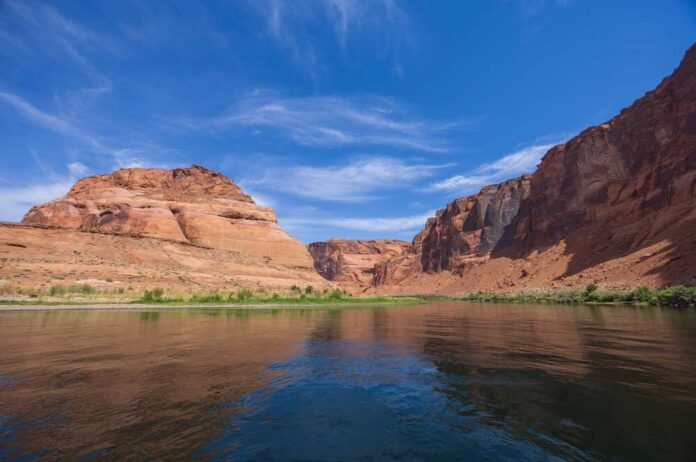
Lake Powell is now just 27 feet above the elevation where Glen Canyon Dam goes dark — and the water is still falling.
Story Snapshot
- Lake Powell sits at roughly 3,524 feet — only 24 feet above the level at which the dam stops generating electricity.
- The reservoir dropped 36 feet in a single year and now holds just 23-24% of its total capacity.
- The Bureau of Reclamation cut water releases from 7.48 million to 6 million acre-feet through September 2026 to slow the decline.
- Forecasters project inflow for 2026 at just 34% of the long-term average, making recovery unlikely this year.
What “Dead Power Pool” Actually Means
Two terms keep getting mixed up in the news, and the difference matters. The “minimum power pool” sits at 3,500 feet. That is where Glen Canyon Dam’s turbines stop spinning and the electricity stops flowing.
The “dead pool” is a much lower 3,370 feet — the point where no water can leave the reservoir at all. Lake Powell has not reached either threshold, but at roughly 3,524 feet, it is closer to the power cutoff than at any point since the reservoir finished filling in the 1960s.
The Bureau of Reclamation’s own data tells the story plainly. At the start of January 2026, the agency projected the lake at 3,538 feet. It is now measurably below that figure and still dropping.
The Colorado Basin River Forecast Center put projected inflow for water year 2026 at just 3.27 million acre-feet — 34% of the historical average. That is not a rounding error. That is a river running at one-third of normal.
The Government Is Already in Emergency Mode
The Bureau of Reclamation did not wait for headlines to act. The agency cut water releases from Glen Canyon Dam — reducing the outflow from 7.48 million acre-feet down to 6 million acre-feet through September 2026. That reduction is designed to buy the reservoir roughly 54 feet of elevation by April 2027, according to agency projections.
Releases from Flaming Gorge reservoir upstream are also being used to add water through the same period. These are not routine adjustments. Emergency release cuts of this size signal that officials view the situation as genuinely serious.
The media framing — “nearing dead power pool” — is technically accurate but slightly ahead of what official documents say. The Bureau of Reclamation provides the elevation data but has not issued a formal declaration using that exact phrase.
That gap gets filled fast by advocacy groups and YouTube channels, some of which blur the line between the power pool threshold and the far more severe dead pool level. Readers deserve to know the difference.
This Is Not a New Crisis — It Is a Worsening One
The Colorado River Basin has been in a documented megadrought for more than two decades. Between January 2000 and April 2023, the combined water stored in Lake Powell and Lake Mead fell by 33.5 million acre-feet. That is not a weather event.
That is a structural mismatch between how much water seven states and Mexico were promised in 1922 and how much the river actually delivers in the 21st century. The 1922 Colorado River Compact divided water based on the wettest decades in recorded history. The math has never recovered.
Lake Powell reaching critically low elevation levels, nearing 'dead power pool,' experts say
As of Monday, water levels at Lake Powell measured at 3,524.3 feet above sea level, according to the @USBR tracker. https://t.co/SzEBusvdse
Minimum, or "dead," power pool — in which… pic.twitter.com/p9T8qb8mJw
— Water Mark 🚰 (@OtayMark) July 14, 2026
Emergency federal interventions have come in waves since 2020 — a Tier 1 shortage declared in 2021, mid-year release reductions in 2022, and reservoirs hitting their lowest recorded levels in 2022 and 2023.
Each cycle brings new warnings. Each cycle also brings new federal action that has, so far, kept the water above the most catastrophic thresholds. That track record is real. But it also masks how much closer each cycle gets to the line.
Who Is Sounding the Alarm and Why It Matters
The two most-quoted experts in current coverage — Eric Balkin and Zana Stutts — both work for the Glen Canyon Institute, an organization founded in 1996 with a specific goal: drain Lake Powell and restore Glen Canyon. That does not make their data wrong.
The elevation numbers come from the Bureau of Reclamation, not from advocacy groups. But readers should know that the loudest voices calling this a crisis also have a long-standing policy position that benefits from the reservoir being seen as failing. That is worth keeping in mind when evaluating how the story is framed.
What Happens If the Dam Goes Quiet
Glen Canyon Dam powers homes and businesses across the Southwest. Losing that hydroelectric output does not mean the lights go out overnight — the grid has other sources.
But it removes a significant, reliable power source that has served the region for decades, and it would add cost and strain on a Western grid already under pressure.
More critically, once the lake drops below the power pool threshold, the dam’s ability to manage water releases through its lower outlets becomes limited by engineering design. Getting water out of a near-empty reservoir is harder than it sounds.
The numbers are real, the trend is real, and the federal response is already underway. Whether this year’s emergency measures hold the line — or whether Lake Powell sets a new record low in August 2026 as some experts now predict — will depend almost entirely on how much snow falls in the Rocky Mountains between now and spring. That is not a policy lever anyone controls.
Sources:
abcnews.com, usbr.gov, facebook.com, powell.uslakes.info, colorado.edu